


Overstimulated dog on walks? Why your dog can't listen and how to help them regulate.

My dog won’t take treats outside
I hear this all the time.
“He’s just not food motivated.”
“She doesn’t care about treats on walks.”
Often, it’s not about motivation, its about arousal.
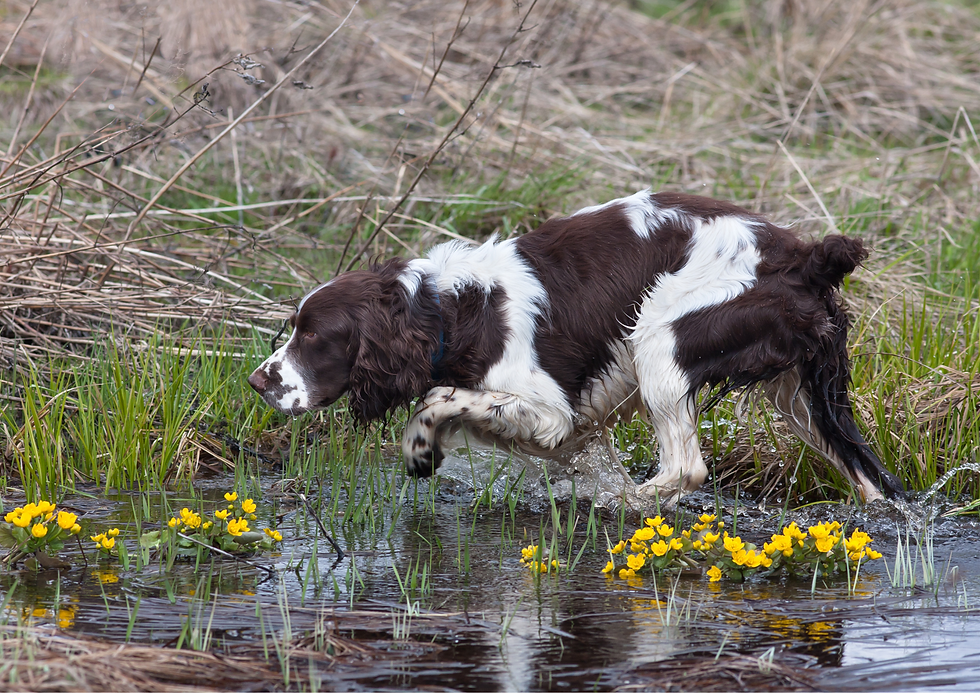
When a dog steps into an environment full of scent, movement and possibility, their nervous system ramps up, in an environment where may predict wildlife they may be overstimulated. Are they showing signs of their muscles tensing? Their breathing shifts? Their eyes scan constantly?
They’re not ignoring you.
They’re overwhelmed.

What high arousal actually looks like in dogs.
Prey drive starts long before the chase.
The nose lifts.
The body stiffens.
The eyes lock onto the horizon.
If your dog is in this state for the entire walk, they never truly settle. They’re constantly preparing, d a dog who is highly stimulated cannot learn.
If you'd like to understand more about PST and whether it could help your dog, you can read my introduction to Predation Substitute Training here or book a free discovery call and we can talk through what's happening on your walks.
How PST uses regulation to build connection
This regulation work sits at the heart of Predation Substitute Training (PST). Before we can work with a dog's prey drive before any of the games, the stalking deal, or the structured activities, we first need to help them access a calmer state. One where they can actually take in information, notice you, and make choices.
A dog in high arousal is running on instinct alone. They're not being difficult they're simply not in a place where learning is possible. And this is one of the most important shifts owners make when they come to work with me:
"helping owners understand that regulation isn't a detour from training.
It is the training"
One of the most powerful tools we have for this is something incredibly simple licking. Not grabbing treats, not rapid-fire rewards, but slow, sustained licking. Of all the ways we can help our dogs regulate outdoors, licking is the most effective. It activates the parasympathetic nervous system the calm, safe, "rest and digest" state, and counteracts the fight-or-flight response that high arousal triggers. It also mimics early nursing behaviour, making it deeply soothing at a neurological level. Teaching your dog to lick from a spoon, a pouch, or your hand outside isn't just a nice trick, it's one of the foundations of PST work, and often the first thing we practise together.
Once your dog learns that the outside world doesn't have to mean constant high alert — that they can move, pause, lick, breathe, and still be safe everything else becomes possible. The PST games land better. The connection deepens. And walks start to feel like something you both actually enjoy.
A simple walk structure for overstimulated dogs
Instead of one long, high-energy walk, try this:
Walk for one minute.
Stop.
Let your dog lick or calmly eat for 30 seconds.
Then walk again.
This stop-start pattern helps your dog oscillate between movement and regulation.
Over time, they learn they don’t have to be “on” the entire time.
The calm feeding game
Bring a small pot of something soft (natural yoghurt, blended dog-safe pâté, or soaked kibble).
On your walk:
Stop before your dog escalates.
Sit or crouch down.
Let them lick slowly for 20–30 seconds.
Then resume walking calmly.
You’re teaching their body how to settle in the environment.

Comments